
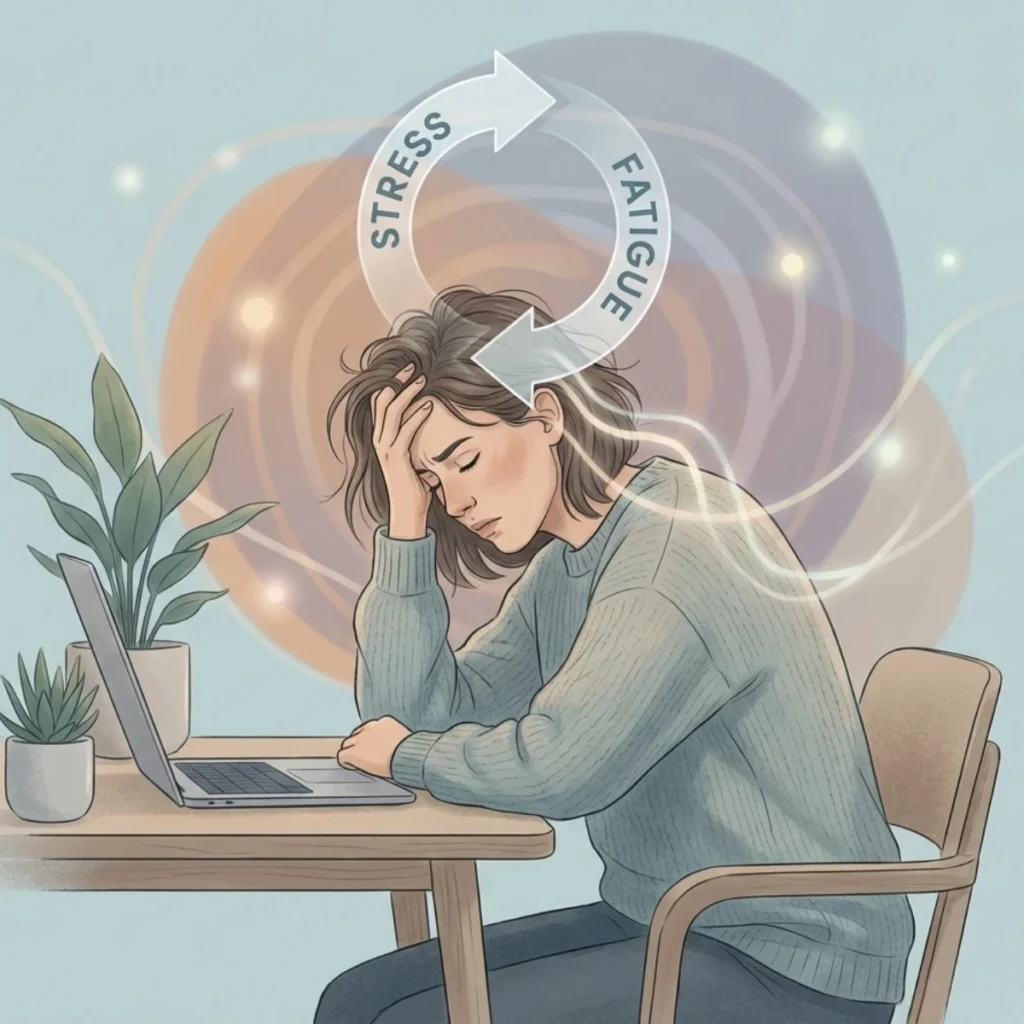
The Energy–Stress Loop: Why Mental Pressure Makes You Physically Tired
The energy stress loop explains one of the most confusing modern health problems: why mental pressure so often turns into physical exhaustion. You may not be overtraining, skipping sleep, or eating poorly—yet your body feels heavy, weak, and drained.
This happens because stress does not stay in the mind. Instead, it moves through the nervous system, hormones, metabolism, and cellular energy systems. Over time, mental pressure becomes physical fatigue.
In this article, we’ll break down how the energy–stress loop works, why it keeps repeating, and—most importantly—how to interrupt it.
What Is the Energy–Stress Loop?
The energy–stress loop is a self-reinforcing cycle where mental stress reduces physical energy, and low energy increases stress even further.
It usually looks like this:
- Mental pressure increases
- The nervous system enters fight-or-flight
- Energy production becomes inefficient
- Physical fatigue appears
- Low energy creates more mental stress
Once this loop is established, rest alone rarely fixes it.
Why Mental Stress Feels Physical
From a biological perspective, stress is a full-body event. When the brain perceives pressure—deadlines, uncertainty, overload—it signals danger.
As a result, the body releases stress hormones like cortisol and adrenaline. These hormones are useful in short bursts, but harmful when elevated for long periods.
Over time, chronic stress leads to:
- Muscle tension
- Reduced digestion
- Lower cellular energy output
- Impaired recovery
This is why mental stress so often turns into physical tiredness.
The Nervous System: Where the Loop Begins
The autonomic nervous system controls energy allocation. When stress is high, the sympathetic (fight-or-flight) branch dominates.
In this state:
- Blood flow shifts away from digestion
- Muscles remain semi-contracted
- Energy is diverted toward survival, not recovery
Although this response is adaptive short-term, long-term activation drains energy reserves.
Cortisol and Energy Depletion
Cortisol helps mobilize energy during stress. However, chronically elevated cortisol disrupts energy regulation.
Over time, this leads to:
- Blood sugar instability
- Poor sleep quality
- Increased inflammation
- Reduced mitochondrial efficiency
This explains why many people feel tired even when they are “not doing much physically.”
Blood Sugar Swings Amplify the Stress Response
Stress hormones directly affect blood glucose. When cortisol rises, blood sugar often spikes—followed by sharp drops.
These crashes trigger fatigue, anxiety, and mental fog, reinforcing the energy–stress loop.
This mechanism is explained in detail in
Blood Sugar and Energy: Why Your Levels Crash and How to Stabilize Them.
Mitochondria Under Stress: Less Energy Per Cell
Mitochondria are responsible for producing ATP, the body’s usable energy. Chronic stress reduces mitochondrial efficiency.
When mitochondria are stressed:
- Energy output drops
- Recovery slows
- Fatigue becomes persistent
This is why stress-related fatigue often feels deeper than normal tiredness.
Why Sleep Doesn’t Break the Loop
Many people assume sleep will fix stress-related fatigue. However, if the nervous system remains activated, sleep quality suffers.
Stress reduces deep sleep and REM sleep—the very stages needed for recovery.
This is why people can sleep eight hours and still wake up exhausted.
For a deeper explanation, see
How Sleep Quality Affects Your Energy Levels.
Hydration and Stress Fatigue
Stress increases fluid loss and raises the body’s need for hydration. Even mild dehydration increases perceived effort and fatigue.
When dehydration combines with stress, energy drops faster than expected.
This connection is explored further in
Why Hydration Affects Your Energy More Than You Think.
Inflammation: The Long-Term Cost of Stress
Chronic psychological stress promotes low-grade inflammation. Inflammatory signals interfere with neurotransmitters, hormones, and energy production.
Research from the National Institutes of Health links inflammation directly to fatigue and reduced physical performance.
NIH – Inflammation, Stress, and Fatigue
Why Low Energy Increases Mental Pressure
Low energy reduces cognitive flexibility, emotional regulation, and motivation. As a result, everyday tasks feel harder.
This creates frustration, worry, and self-criticism—feeding mental stress and restarting the loop.
Breaking the Energy–Stress Loop
The key to breaking the energy–stress loop is not eliminating stress, but restoring recovery signals.
Effective strategies include:
- Stabilizing blood sugar
- Reducing evening stimulation
- Supporting parasympathetic activation
- Improving mitochondrial health
- Prioritizing hydration
When the body senses safety, energy production naturally improves.
Why Rest Alone Is Not Enough
Rest without nervous system downregulation does little to restore energy. The body must exit survival mode.
This is why many people feel better after calm movement, nature exposure, or breathwork than after passive rest.
FAQ: Energy and Stress
Can mental stress really cause physical fatigue?
Yes. Stress alters hormones, nervous system activity, and cellular energy production.
Why does stress fatigue feel different from exercise fatigue?
Stress fatigue is deeper and more persistent because it affects recovery systems, not just muscles.
How long does it take to break the energy–stress loop?
Many people notice improvements within 1–2 weeks when addressing stress and recovery simultaneously.
Does caffeine help or worsen the loop?
Caffeine masks fatigue temporarily but often worsens stress-related exhaustion long term.
Pingback: Metabolic Flexibility: The Key to All-Day Energy - mindenergyhub.com
Pingback: Why Modern Life Is Designed to Drain Your Energy - mindenergyhub.com
Pingback: Mental Fatigue vs Physical Fatigue: How to Tell the Difference - mindenergyhub.com
Pingback: Why You Feel Tired Even When You Sleep Enough - mindenergyhub.com